

CR-V vs Tiguan vs CX-5 Compact SUV Showdown

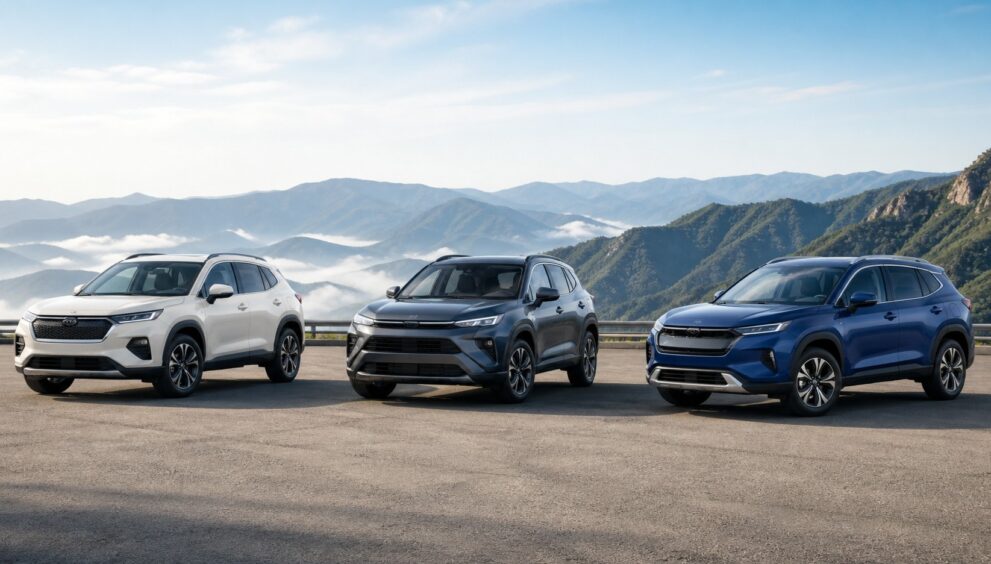
Shopping for a small SUV around the $40,000 mark means sorting through a lot of noise. The Honda CR-V, Volkswagen Tiguan, and Mazda CX-5 all want a spot in your driveway, and each one makes its pitch in a completely different way. One plays it safe, one shows off, and one loads up on gear. Figuring out which approach actually fits your life is the whole game here.
- The Honda CR-V wins on everyday usability, cargo room, and three-across seating.
- The Mazda CX-5 packs the longest feature list but stumbles on finicky controls.
- The Volkswagen Tiguan makes the boldest impression with modern styling and a driver-focused cabin.
First Impressions Play Out Three Ways
The Honda looks the most familiar of the bunch. Its current generation dates back to 2023, so the clean proportions and traditional lights feel a little conservative next to the newer rivals. The Mazda, all-new for 2026, takes a similarly restrained approach but wears a more polished surface. The Volkswagen, redesigned for 2025, leans hardest into the moment with a flatter, wider stance and lighting that stretches across the front and rear. Even though the CX-5 is technically the newest, the Tiguan stands out the most.
Inside, the story shifts. The CR-V keeps things orderly and easy to read, with physical climate controls and conventional stalks. Some materials feel merely adequate, and the 9.0-inch touchscreen is starting to show its age. The CX-5 makes the richest first impression thanks to upscale materials, heated rear seats, and a huge optional 15.6-inch display. The Tiguan counters with slick screen integration, ambient lighting, and a center display tilted slightly toward the driver.
What Roughly $40,000 Actually Buys
Each SUV spends that money differently. The Honda has the shortest feature list. The EX-L skips the 360-degree camera, ventilated front seats, head-up display, and panoramic roof that show up on one or both rivals. At this price, those gaps sting a bit. Still, the Honda’s tech is the easiest to live with, with responsive menus and controls that keep you out of touchscreen submenus.
The Mazda swings the opposite way and loads up on content. Its Premium Plus grade layers in cooling for the front seats and warmth for the rear ones, caps the cabin with a panoramic moonroof, and pairs a Bose stereo with that oversized display, a sharp camera system, and built-in Google services. On paper that reads like the strongest value here. Reality proved messier, with deleted profiles, Apple CarPlay dropouts, and generally flaky infotainment that a dealer software update didn’t fully cure. The Tiguan lands in between, offering a driver-angled screen and head-up display, though some sought-after items sit one trim higher and the absent power passenger seat near $41,000 is a curious omission.
The Daily Grind Sorts Them Out
Equipment counts only register up to a point. A compact SUV proves its worth by smoothing out daily routines, and that is the CR-V’s home turf. Climb in and the driving position, outward visibility, cubby space, and switchgear all make immediate sense. Someone driving it home for the first time can set the temperature, fan speed, and vents by feel, with no menu diving required. The Tiguan has clever concepts but expects you to adapt to its habits, including touch-sensitive controls on the roof and column stalks that take some getting used to. The Mazda presents as premium yet pushes too many everyday tasks through an interface that fights back.
The second row tightens things up. Two adults might sit most comfortably in the Tiguan, whose outboard seats have a bucketlike shape. But add a third passenger and the Honda’s wide bench and flat floor win easily. Cargo tells the same tale. The CR-V has the largest, most useful hold plus clever small-item storage, while the Volkswagen’s smaller area is smartly shaped and the Mazda offers respectable but unremarkable room. The test did not include a used 2021 Nissan Rogue, so it provides no basis for a direct comparison with that model.
Picking the One That Fits Your Week
The road test separated the three by character as well as equipment. Reviewers regarded the Tiguan as the liveliest to drive, found the CR-V especially easy to judge, and thought the Mazda’s behavior did not fully match the brand’s performance-oriented image. Their overall preference went to the Honda because its cabin controls, passenger space, and cargo area worked consistently in ordinary use. The Volkswagen’s presentation and the Mazda’s feature list remained points in their favor, but neither displaced the CR-V in the test’s final assessment.
This post may contain affiliate links. If you buy products through these links, we may receive a commission, at no additional cost to you.