
Hyundai’s Space-Age Minivan Could Actually Land in America

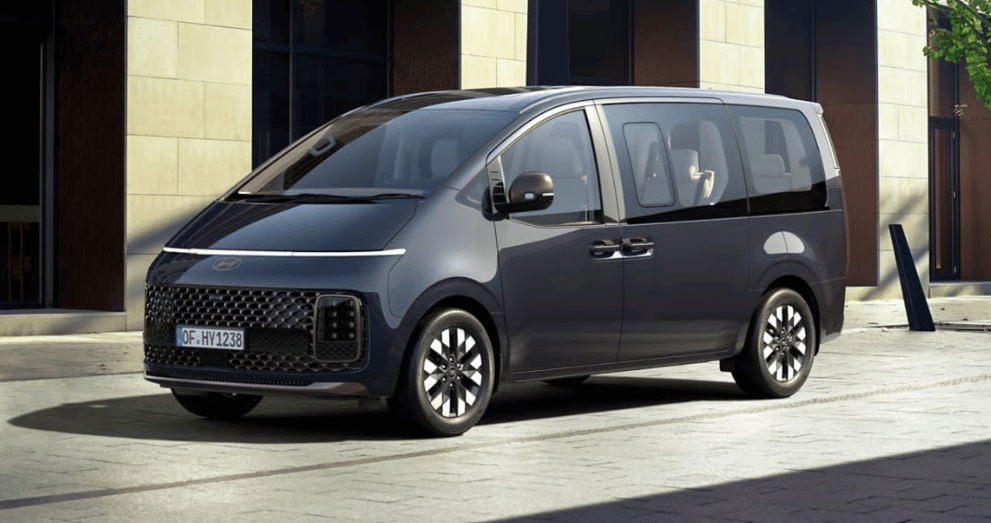
For years, American van fans have watched with envy as Hyundai sold its futuristic Staria minivan everywhere except here. That might be about to change. The electric version of this spaceship-on-wheels just debuted at the Brussels Motor Show, and there are serious signs pointing to a US arrival. When Hyundai Motor America posted the Staria Electric on its own media site, the rumor mill kicked into overdrive.
- The Staria Electric will arrive in Korea and certain European markets in the first half of 2026, with arrival timing for other regions to be confirmed later.
- The electric minivan will travel more than 249 miles on a single charge of its 85-kilowatt-hour battery on the WLTP scale.
- The front-drive Staria Electric has a single electric motor putting out 215 horsepower.
What Makes This Minivan Special
Hyundai’s space-age minivan, which so far has been limited to South Korea, Australia, South Africa, and several Eurasian markets, is going global at the same time that it goes combustion-free. The design language sets it apart from traditional boxy vans. The clean lines, huge windows, and wide light bar made it look like an EV from the start, even when gas-powered models debuted back in 2021.
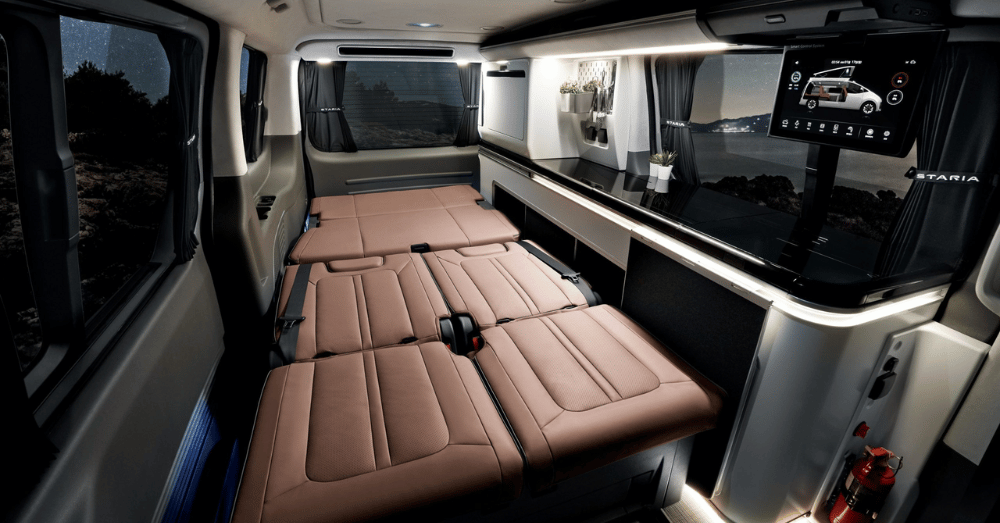
At about 207 inches long and with a 129-inch wheelbase, it’s a true full-size van that’s also a bit taller than competitors, which adds to its van-like feel. The interior dimensions are equally generous. The Staria EV features a flat floor, a high roof, and a lounge-style layout available as a 7-seater Luxury or a 9-seater Wagon, so it works for families or commercial use.
The Electric Powertrain Delivers Where It Counts
Power output won’t impress anyone looking at raw numbers. The front-drive Staria Electric has a single electric motor putting out 215 horsepower, which would make it the least powerful minivan on the market if it indeed comes to the US, as the single-motor Volkswagen ID. Buzz has 282 hp, for example. The charging system tells a different story.
The charging system is part of an 800-volt electrical architecture, with Hyundai targeting a 10-to-80-percent charge time of around 20 minutes, meaning adding at least 160 miles of range in a quick charging stop. That’s the same fast-charging tech found in the Ioniq 5 and Ioniq 6, making it stand out from most competitors stuck with 400-volt systems.
Translated to the more realistic EPA scale, the Staria should still travel 220 miles or so per charge. That’s not terrible for a vehicle this size. Hyundai’s European arm is targeting a 4,000-pound towing rating for the Staria EV, allowing it to stand in as a camper tow vehicle on short weekend jaunts.
The American Minivan Market Dilemma
If you’re thinking about heading to your local Hyundai dealership to put down a deposit, hold on. There’s a reason this van has been forbidden fruit for so long. A US launch isn’t ruled out, but with Americans still leaning toward SUVs over minivans, it’s hard to say whether it will make it here, and the ID. Buzz, which VW reportedly stopped selling toward the end of last year, only sold just over 6,100 units in 2025.
The minivan segment isn’t dead, but it’s not exactly thriving either. The Chrysler Pacifica and Toyota Sienna still command the market, with the Kia Carnival (Hyundai’s corporate cousin) doing respectable business. An electric minivan represents an even smaller niche within an already shrinking segment.
Unlike the IONIQ 9 crossover, which rides on an EV-specific platform, the Staria Electric shares its architecture with a combustion-engine variant. This could actually work in its favor for pricing, as dedicated EV platforms tend to be more expensive to develop and produce.
Could This Actually Happen?
The signs are pointing in a promising direction. The company’s American media division announced the electric minivan, igniting rumors that Hyundai would field a VW ID. Buzz competitor. Why would Hyundai Motor America bother posting it on their media site if they had zero intention of bringing it here?
There’s also the matter of timing. With the ID. Buzz struggling to find buyers and eventually being discontinued for 2026, there’s a gap in the market for an electric minivan. The Staria could fill that void, especially if Hyundai prices it competitively.
The dashboard is dominated by two 12.3-inch screens, but there are still physical buttons for the basics, and there’s plenty of storage, flexible seating, and huge windows. These practical touches could appeal to families tired of touchscreen-only interfaces.
Should You Get Your Hopes Up?
Hyundai’s North American arm has been asked for confirmation that the electric minivan will be offered here. Until an official announcement comes, this remains in rumor territory. But the pieces are aligning.
Electric vehicles continue gaining ground in America, and Hyundai has proven they know how to build solid EVs. The IONIQ 5 and Ioniq 6 have both earned strong reviews and decent sales numbers. The company has also committed billions to expanding EV production in the United States.
What the Staria Electric offers is something genuinely different in the American market. The design embraces the minivan format fully, with futuristic styling that gives it personality. The 800-volt charging system provides real-world convenience, and the spacious interior delivers what minivan buyers actually want: room for people and stuff.
American buyers might finally get a chance to see if an electric minivan straight out of a sci-fi movie can find a home in their driveways. After years of watching this thing from afar, at least there’s finally hope we might get to experience it firsthand. Watch for official announcements later this year.
This post may contain affiliate links. If you buy products through these links, we may receive a commission, at no additional cost to you.