
Hyundai’s Boulder Concept Wants to Take on the Bronco, Wrangler, and Everything In Between

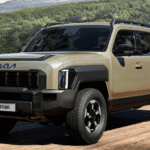
Hyundai dropped a surprise at the 2026 New York International Auto Show that had auto journalists scrambling and competitors paying attention. The Hyundai Boulder Concept, a boxy and brawny body-on-frame SUV, rolled into the Javits Center on April 1 with zero advance press materials and a whole lot of attitude. It previews a new direction for the brand and sets the stage for Hyundai’s first-ever ladder-frame pickup truck, expected by 2030.
- The Hyundai Boulder Concept made its surprise global debut at the 2026 New York International Auto Show, previewing Hyundai’s first fully-boxed body-on-frame architecture.
- The new ladder-frame platform supports electric, combustion, and hybrid powertrain layouts, giving Hyundai flexibility based on market conditions.
- The body-on-frame truck is one of 36 new Hyundai vehicles coming to North America by 2030.
A First for Hyundai on American Soil
Every production Hyundai sold in the United States currently sits on a unibody platform. The Boulder Concept flips that playbook entirely. Unveiled as a surprise on April 1, the body-on-frame off-road SUV previews Hyundai’s first fully boxed ladder-frame architecture, a platform slated to underpin a production midsize pickup truck by 2030.
Hyundai is going all in. The Boulder is the public face of an $18.4 billion manufacturing commitment. Hyundai’s $12.6 billion Metaplant in Georgia already produces the Ioniq 5 and Ioniq 9, and a separate $5.8 billion steel plant in Louisiana, Hyundai’s first North American steel facility, will produce 2.7 million metric tons of steel annually.
The Boulder Concept’s creation was led by the Southern California-based team at Hyundai Design North America. And Hyundai noted that the upcoming production truck will be entirely designed and developed in America and ultimately assembled in America using American steel.
Tough Looks Built Around “Art of Steel”
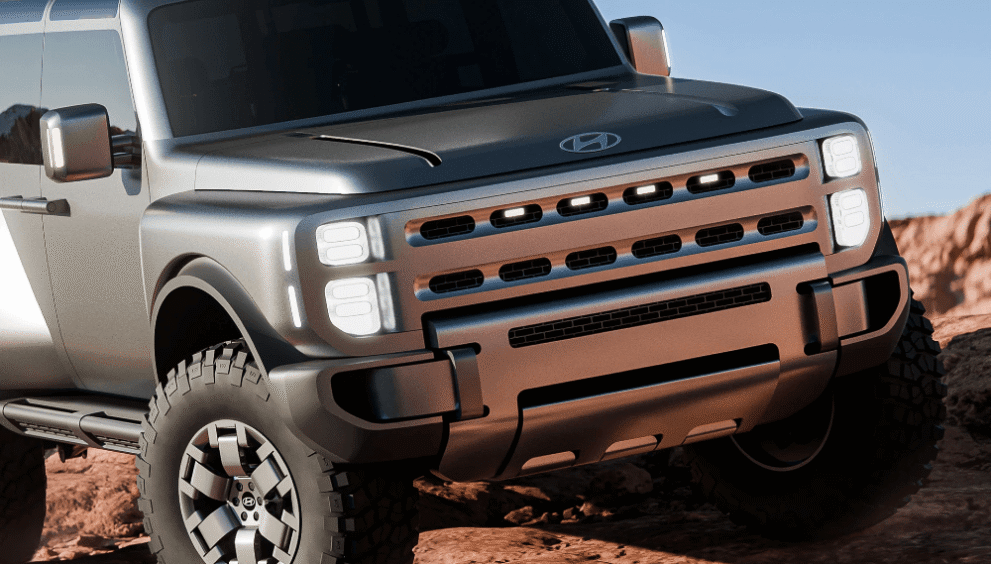
The Boulder Concept draws heavily from Hyundai’s “Art of Steel” design philosophy, which turns steel’s natural strength into sculptural, functional beauty. That design language shows up everywhere on this concept, from its muscular fender flares to its upright, two-box silhouette.
The overall silhouette presents an upright greenhouse that offers a commanding view and excellent visibility. Dual safari-style fixed upper windows flood the cabin with light, while coach-style doors allow better side-loading access for both rows. A stout, low-profile roof rack includes steel webbing between the roof rails for extra cargo-carrying capability.
Hyundai says the Boulder’s boxy design gives the SUV aggressive approach, departure, and breakover angles along with a generous fording depth. Sitting on 37-inch mud-terrain tires (37×12.50R18 LT) on 18-inch wheels, with a full-size spare mounted on the tailgate, this thing looks trail-ready straight out of a dream garage.
The tailgate features a double-hinge that opens in either direction and a power drop-down rear window. And the grille comes with two rows of pill-shaped openings studded with daytime running lamps that denote the letter ‘H’ in Morse code. Talk about hidden details.
A Cabin That Ditches Screens for Something Better
The interior might be the most interesting part of the whole package. The SUV’s cabin has a Cyberpunk-inspired design with centrally placed gauges, a square steering wheel, chunky elements on the dashboard, and prominent grab handles.
Unlike most modern vehicles, the concept skips an instrument cluster and a touchscreen in favor of a pillar-to-pillar head-up display that projects information directly onto the windshield. Controls are chunky physical dials and switches meant for gloved hands. A modular rail system lets occupants mount their own devices, and fold-out tray tables serve as trailside workstations.
A software-driven real-time off-road guidance system acts as what Hyundai describes as “a digital spotter sitting shotgun,” providing terrain analysis and driving recommendations during off-road use. That’s the kind of tech that actually makes sense on a backcountry trail.
Who Should Be Worried?
As an SUV, the Boulder targets the Ford Bronco, Jeep Wrangler, Land Rover Defender, and Toyota 4Runner. The production pickup truck will compete against the Toyota Tacoma, Ford Ranger, Chevrolet Colorado, and Nissan Frontier.
The midsize truck market produces nearly 1 million units annually in North America and grew 10.2% in the first quarter of 2026. Hyundai clearly sees an opening in one of the most profitable segments in the auto industry. Hyundai is now the world’s third-largest automaker, well ahead of GM, Stellantis, and Ford. So when the Korean brand says it’s coming for the truck segment, the established players have reason to take notice.
Because the Boulder is a design study, there are no powertrain specs to report yet. But the body-on-frame platform is built to accept pure electric, internal combustion, and hybrid configurations, which gives Hyundai room to adapt to whatever buyers want by the time production rolls around.
What the Boulder Means for Hyundai’s Future
The Hyundai Boulder Concept is a bold statement about where the brand plans to go next. It was the biggest news at the 2026 New York International Auto Show, and Hyundai intends to launch several products drawing influence from this concept by 2030. Hyundai’s unibody-based Santa Cruz pickup will be discontinued after this model year, while Hyundai’s Alabama and Georgia factories will have the capacity to build an all-new ladder-frame platform.
Whether or not every wild styling cue on the Boulder makes it to a production line, the message is crystal clear: Hyundai is building trucks, building them in America, and building them to compete at the top of the segment. For off-road fans and truck enthusiasts who’ve been waiting for a fresh option, the next few years look very promising.
This post may contain affiliate links. If you buy products through these links, we may receive a commission, at no additional cost to you.